
School dance planning
Gym vs Ballroom: Sound Planning for School Dances
Your committee has picked the date and the playlist, but the room is a gym, and everyone remembers how echoey it sounds during assemblies. Where the dance happens changes what you need to plan for sound.
This guide compares a school gym with a ballroom or rented hall, then covers speaker placement, power, microphones, and a sound check. It draws on published venue and acoustics guides and leaves room-specific answers to your facilities office.
Why the room changes the sound plan
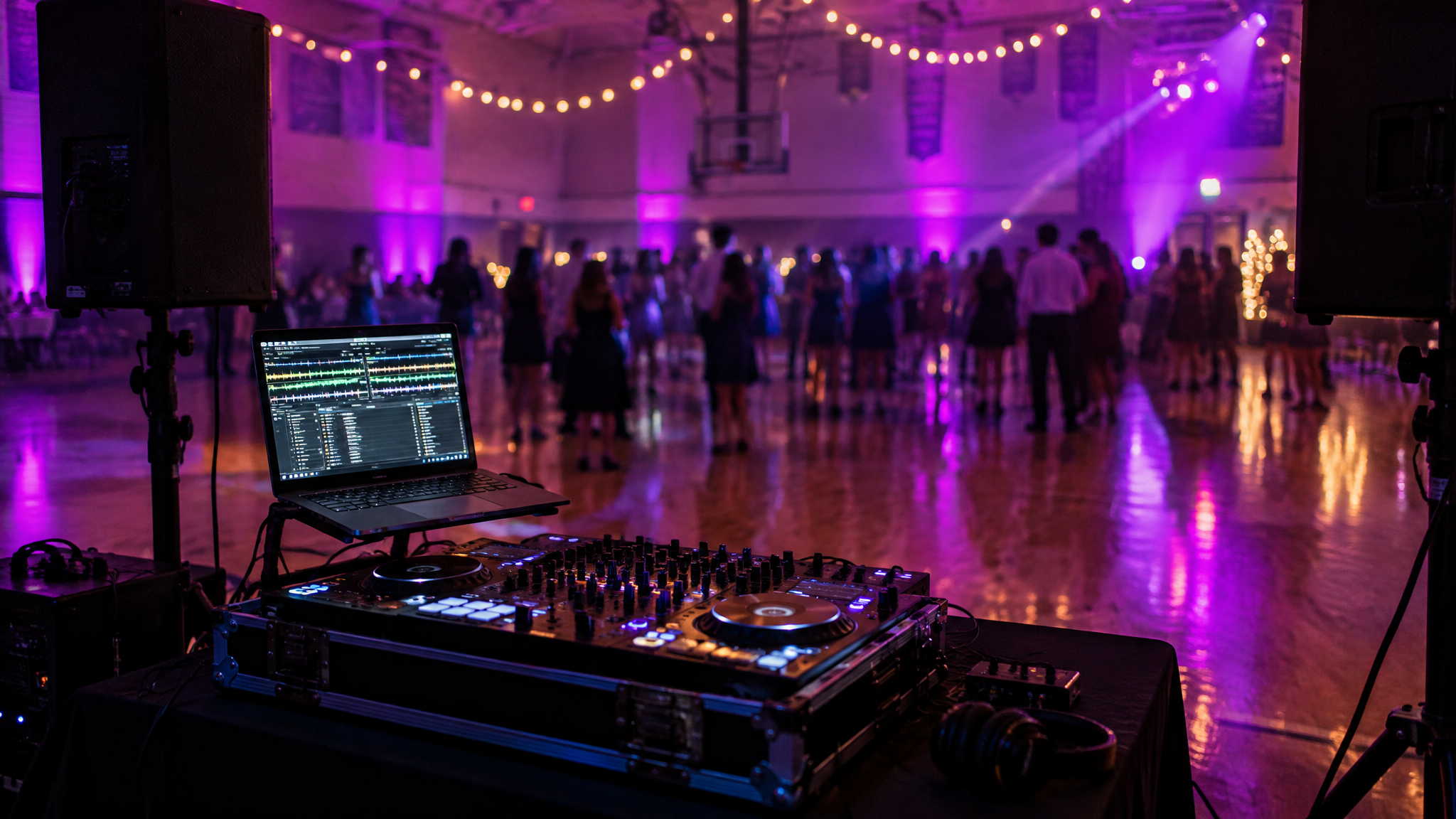
A school dance sounds different in every room, and the biggest swing is between a gym and a ballroom. The TOA sound basics article says school gymnasiums are often known as one of the most challenging architectural settings acoustically, because hard, flat floors, walls, and ceilings drive echo and reverberation. A rented hall or ballroom is built for people to gather, so the same playlist usually behaves better there.
That does not mean the gym is a bad choice. For many schools it is the only practical one. It means the sound plan, not the playlist, should be the first thing your committee adjusts when the room is a gym.
Gym or ballroom: what to compare
The walk-a-thon.com venue guide compares common school event rooms on floor, acoustics, power, and cost. Its table describes the school gym as echoey, with sound that carries into hallways and often limited outlets, some on shared circuits. A rented hall or ballroom is described as dance-ready, with good acoustics and usually adequate power, but with deposits and minimums attached. Use the comparison below as a starting checklist, then confirm each item with the actual venue.
| Question | School gym | Ballroom or rented hall |
|---|---|---|
| How does it sound? | Echoey, with sound that carries into hallways | Generally good, though every room differs |
| How is the power? | Often limited outlets, some on shared circuits | Usually adequate, so ask the venue |
| Who controls the room? | Facilities office and custodial staff | Venue manager and its rental agreement |
| Floor rules | Floor covers and shoe rules may apply | Dance-ready floor, with the venue's own rules |
| Main planning task | Control reflections and plan circuits | Match the setup to the room's size and layout |
Notice that the last row differs. In a gym you manage the room. In a ballroom you mostly fit the equipment to it.
Why gyms sound muddy
Reverberation is the time sound lingers after the source stops. In a gym, reflections from hard surfaces overlap with the direct sound, which blurs the beat and makes announcements hard to follow. The TOA article names wall panels, ceiling baffles, and line array speakers as common ways to reduce reflections. Panels and baffles are permanent facility decisions, so for a single dance the realistic lever is how the speakers are placed and aimed.
Speaker placement that helps in a gym
The walk-a-thon.com guide advises powered speakers on stands at the DJ end, aimed at the floor, and notes that for a large gym two speakers on stands carry better than one big speaker on the floor. The ProAcoustics gym sound guide adds that speakers should be placed apart to spread sound evenly, in line with where people need to hear, and kept away from walls and corners because that produces reflections and distortion.
- Put the DJ position at one short end of the room, near power.
- Aim speakers at the dance floor, not at the far wall or the ceiling.
- Use two or more speakers on stands for even coverage in a large gym.
- Keep speakers away from corners and wall surfaces.
- Check the sound from the back wall and from hallways before students arrive.
Think about the hallway
Because gym sound carries into hallways, ask where classrooms, offices, or other events share the building that night. Agree on the area where sound is expected to stay, and ask your chaperones to report anywhere it spills.
A school dance DJ who plans around the room can help your committee manage sound before the doors open. See how school dance DJ service works
Power, cables, and safety
Power is where a dance can quietly go wrong. The walk-a-thon.com guide tells planners to ask facilities which outlets share a circuit before plugging in speakers, lights, and anything else on the same line, and not to daisy-chain power strips. Gym outlets are often limited, so find out early where the independent circuits are.
| Item | What to ask or do | Who to ask |
|---|---|---|
| Outlets near the DJ position | Which circuits they are on and what else shares them | Facilities office |
| Speakers, lights, and other gear | List everything that will draw power before the night | DJ or entertainer |
| Power strips | Do not chain them together | Everyone setting up |
| Cables across walkways | Run them along walls and cover any crossing | Setup crew |
| Exits and doorways | Keep clear of cables, speakers, and tables | Advisor and chaperones |
Ask your entertainer to send a short equipment list in advance so facilities can confirm the circuits match. A simple room diagram that shows the DJ position, speaker positions, and outlets prevents most day-of surprises.
Ballroom and off-campus venues
A rented hall or ballroom changes the questions. The acoustics usually need less correction, but the venue brings its own rules. Read the rental agreement for hours, load-in access, decoration limits, and any equipment or vendor requirements. The walk-a-thon.com guide recommends asking the facilities office or venue for its facility-use agreement as soon as you have a date, and reading it for hours, fees, insurance, and prohibitions.
Match the setup to the room
A ballroom may have a stage, a fixed lighting setup, or a house sound system. Decide early whether you will use any of that or bring your own, and who is responsible if the house system fails. Ask what the room's posted capacity is, and plan the dance floor, seating, and entrance around it.
Some venues need more than a speaker and a table, such as staging, lighting, and a planned layout. Learn about school event production
Volume and clarity
In an echoey room, more volume is not a fix. The walk-a-thon.com guide stresses a sound check at the event volume, from the back wall, with someone who will watch the level during the event. An empty gym sounds different from a full one, because people absorb sound, so plan to adjust once the room fills.
Sound check checklist
- Run the check at the volume you expect during the dance.
- Listen from the back wall, the corners, and the hallways.
- Test the announcement microphone, because speech clarity matters as much as the beat.
- Have a backup device with the same playlist ready.
- Assign one person to watch the level as students arrive.
Microphones and announcements
Announcements are the part of the night where a muddy room is most obvious. The ProAcoustics guide says handheld microphones suit speeches and announcements, and that wired microphones are often more reliable and more affordable than wireless ones. For a dance, plan one microphone for announcements and a backup, and decide in advance who is allowed to use it and when.
Plan a short run of show for sound
List the moments that need clear speech, such as welcome remarks, court or royalty announcements, and prize drawings. Share that list with your entertainer so levels and microphone checks are planned for each one.
A week-by-week planning timeline
| When | Task | Owner |
|---|---|---|
| 4 weeks out | Confirm the room, the hours, and the facility-use rules | Advisor |
| 3 weeks out | Share the room details and expected crowd size with your entertainer | Advisor |
| 2 weeks out | Confirm circuits, outlets, and cable routes with facilities | Advisor and entertainer |
| 1 week out | Send a simple room diagram to everyone who sets up | Advisor |
| Day of | Sound check at event volume, then adjust as the room fills | Entertainer and advisor |
Common sound planning mistakes
- Treating a gym like a ballroom and expecting the same sound.
- Pointing speakers at walls or ceilings instead of the floor.
- Turning the volume up to fight the echo.
- Plugging every device into the same circuit.
- Skipping the sound check or running it in an empty room.
- Leaving announcements to chance with no backup microphone.
Most of these come down to asking facilities early, writing a short room diagram, and testing before students arrive.
Homecoming and fall dances often land in the gym, so the same sound questions apply. Explore homecoming DJ planning
Common questions
Why does a school gym sound so echoey?
Hard, flat floors, walls, and ceilings reflect sound, so echo and reverberation build up. Panels, baffles, and careful speaker placement all help.
Where should speakers go in a gym for a dance?
A common recommendation is powered speakers on stands at one end, aimed at the floor, with two or more speakers for a large gym and distance from walls and corners.
Is a ballroom always better for sound?
Ballrooms generally sound better than gyms, but every room differs, and venues have their own rules, so confirm details with the venue.
Should we turn the volume up to beat the echo?
No. In a reflective room, more volume tends to blur speech and music. Check the sound at event volume and adjust once the room fills.
What should we ask facilities before the dance?
Ask which outlets share a circuit, where cables can run safely, what the room's rules are, and who to contact on the night.