
School dance planning
Prom Run of Show: A Planning Timeline and Night-of Schedule for Committees
Prom is months away, the venue is booked, and someone asks what time the grand march starts. If nobody can answer, your committee has a calendar but not a plan.
A good prom runs on two schedules: a long countdown that covers venue, vendors, tickets, and headcount, and a one-page run of show for the night itself. This guide covers both, with example timings drawn from published planning resources and tips for working with your DJ and venue.
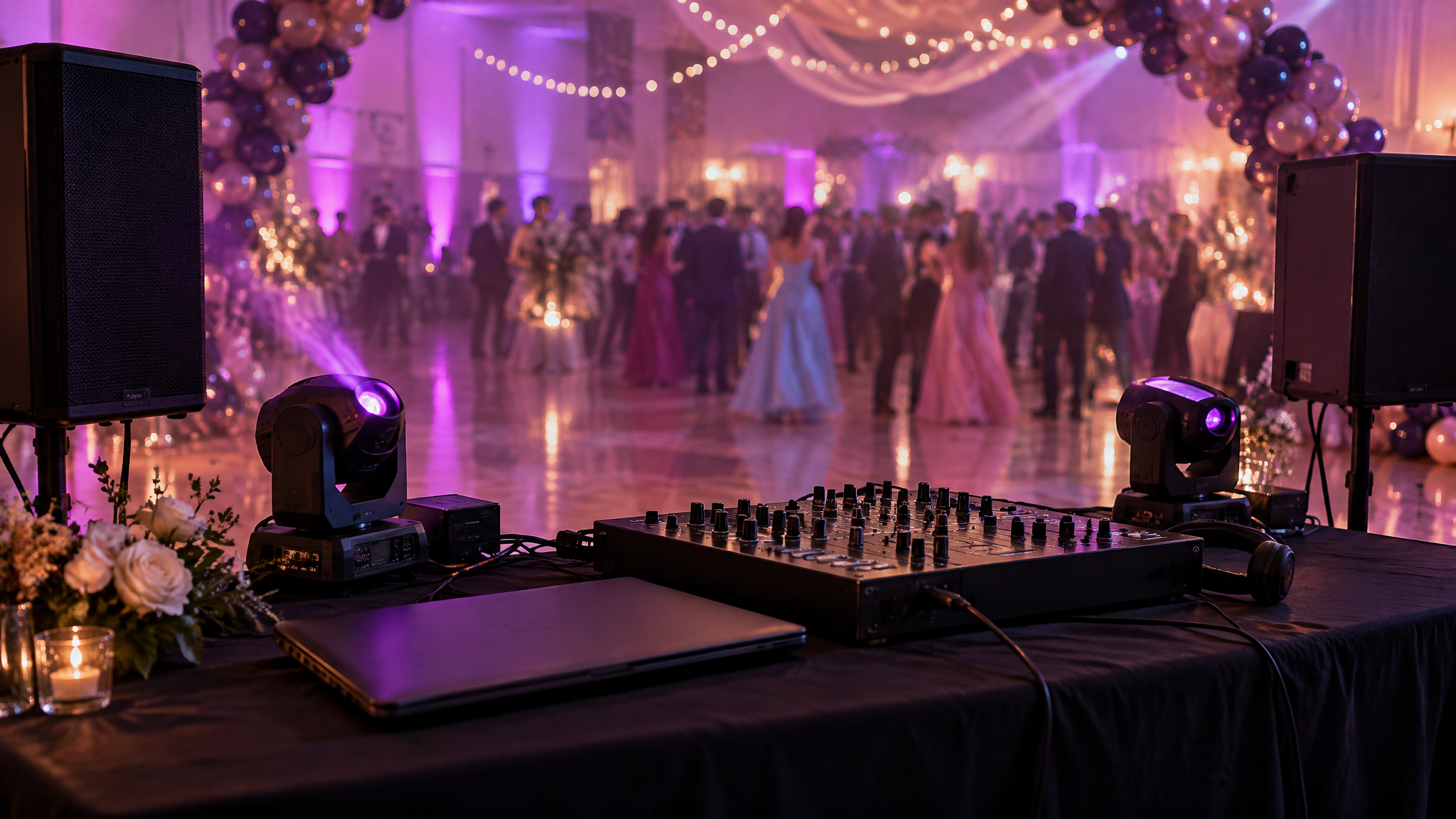
Why a prom needs two schedules
Most committees build one calendar and expect it to cover everything. In practice a prom needs two. The first is the long planning countdown that starts almost a year ahead. The second is the night-of run of show, a minute-by-minute sheet that tells every adult and vendor what happens next. They answer different questions, and mixing them is how a committee ends up choosing a venue in March but arguing about the crowning time at nine o'clock on the night.
The sources we reviewed agree on the broad shape: lock the date and venue early, book high-demand entertainment next, and leave decor and favors for later. They also agree that the run of show should fit on a single page and reach everyone before the event. This guide walks through both schedules and shows where the grand march, the dinner, the prom court, and the DJ fit in.
The long countdown: what happens when
Planning guides for prom committees generally describe a cycle of nine to twelve months. The exact dates depend on your school calendar, but the order of decisions is consistent.
| Time before prom | Main task | Who usually owns it |
|---|---|---|
| 10 to 12 months | Lock the date on school, district, and athletic calendars; tour venues | Advisor and committee chair |
| 7 to 9 months | Secure entertainment and photography; assign committee roles | Entertainment and budget leads |
| 4 to 6 months | Fundraising, catering menu, decor orders | Fundraising and decor leads |
| 6 to 8 weeks | Open ticket sales | Ticket lead and advisor |
| 10 to 14 days | Close ticket sales and send the final headcount to the caterer and venue | Ticket lead |
| Final week | Venue walkthrough, day-of assignments, reminders to vendors and chaperones | Day-of captain and advisor |
Start with the date and the venue
Prom dates compete with wedding season, testing windows, and sports schedules. Check every calendar before you tour a venue, and put the date on the district calendar in writing. Popular rooms fill months ahead, so a late decision usually means a second-choice space.
Book entertainment while there is still a choice
A DJ, MC, and photographer are among the first vendors to book up on popular weekends. Send the venue address, the expected headcount, and your music policy with your first inquiry so the answer you get reflects the real room and the real rules.
If you are still deciding what to ask an entertainment vendor, start with our prom DJ and MC planning page
Close the loop on tickets and headcount
Early ticket sales help you see cash flow and attendance sooner. Closing sales ten to fourteen days out gives the caterer and venue a final number, which keeps food orders and seating charts accurate.
Designing the night-of run of show
A run of show is written for the adults and the committee, not for the students. It lists the time, the activity, the person in charge, and the cue that moves everyone to the next item. A typical prom runs three to five hours, and a four-hour model is the easiest to build around.
| Time | Segment | Cue or owner |
|---|---|---|
| 1:00 to 6:00 PM | Decor setup, vendor load-in, sound and lighting check | Day-of captain, venue manager, DJ |
| 5:30 PM | Chaperone briefing and post assignments | Advisor |
| 6:30 PM | Doors, check-in, ticket and guest form verification | Door team |
| 7:00 PM | Grand march, if your school holds one | MC and photographer |
| 7:40 PM | Dinner with background music | Caterer and DJ |
| 8:30 PM | Dance floor opens | DJ |
| 9:30 PM | Prom court crowning and royal dance | MC and advisor |
| 10:50 PM | Final song and dismissal instructions | DJ and advisor |
| 11:00 PM | Release to parents or after-prom buses; strike begins | Chaperones and cleanup crew |
Treat those times as an example, not a template. Your venue contract, dinner service, and local rules will move them. What matters is that every row has an owner and that the DJ or MC receives the finished sheet at least two weeks ahead, then an updated copy in the final week.
Where the grand march fits
The grand march is a red carpet moment where students are announced and walk a decorated path in front of families. Schools that hold one often run it before the main event, with some recommending a start one to two hours ahead of prom so families can take photos and students can travel. Guides we reviewed describe a typical length of 45 to 90 minutes, and one shorter template blocks about 30 to 45 minutes when the march opens the evening itself.
Keep the march moving
- Print the march order in walking sequence and keep a copy at the entrance.
- Have a committee member confirm each pair or group at the entrance arch before they step out.
- Give the emcee a phonetic spelling for every name that could be mispronounced.
- Set aside seating for families and place the photographer at a fixed spot along the path.
- Print a short program so guests know when the march ends and when dinner begins.
Once the march ends, many schools close the doors to families and apply a no re-entry rule for students. Put that rule in the run of show and in the permission form so nobody is surprised at the door.
Place the crowning and the final dance with care
Several planning guides recommend crowning the prom court about two-thirds of the way through the night rather than at the end. The reason is practical: late in the evening the room starts to empty, and a crowning at that point plays to a handful of people. Doing it while the floor is full keeps the energy up and lets the court have a royal dance before the last block of dancing.
Keep the vote count private. A sealed envelope that only the advisor opens, handed to the emcee at the last moment, prevents leaks and gives the announcement real surprise.
Plan the ending as carefully as the start
Announce the final song ahead of time, turn the house lights up on a set cue, and have chaperones at each exit. If after-prom buses or a parent pickup line are part of the plan, name who directs them. Decide before the event who stays to strike the decor, so the answer is not a question asked at eleven o'clock.
Using the run of show with your DJ and venue
Your DJ and MC are the people who turn a schedule into a night students actually experience. They announce dinner, call the court to the floor, and bring the night to a clean end. They can only do that if the sheet is accurate.
- Send the run of show, the music policy, and the do-not-play list in one packet.
- Provide the MC with names, pronunciations, and the order of announcements.
- Name one adult as the single point of contact for the DJ and venue manager.
- Ask for written confirmation of load-in time, sound check time, and strike time.
- Hold a short final walkthrough to confirm speaker placement, microphone checks, emergency access, and chaperone posts.
For dances beyond prom, including homecoming and winter formals, see our school dance DJ planning page
Build in contingency plans
Weather can disrupt outdoor photos or entry lines, and schedules slip when a caterer runs late. Write a short backup plan: where photos move if it rains, who can authorize dropping a segment, and who calls the vendors if the night shifts. Share an emergency contact chain that does not depend on a student group chat.
Align every step with your district rules on supervision ratios, guest entry, and alcohol-free requirements. If your school uses breath tests, mark where and how that happens on the run of show and brief the administrators and officers who will handle a positive result.
If the room needs more than a DJ, such as staging, sound, and lighting for a large space, read about school event production
After the night: close out the file
Pay remaining invoices, reconcile the ledger, and send thank-you notes to vendors and volunteers. Then save the final run of show with notes about what ran late and what worked. The next committee will start with your file instead of a blank page, and that single habit improves the schedule every year.
Common questions
How far ahead should a prom committee start planning?
Most planning guides recommend nine to twelve months. Start by locking the date on every school calendar, then tour and secure the venue.
How long should a grand march last?
It depends on the number of participants. Guides we reviewed describe a range of 30 to 90 minutes, so build the length from your actual headcount and test it in a short rehearsal.
When should the prom court be crowned?
About two-thirds of the way through the evening. Crowning at the very end often happens in a room that has already started to empty.
What belongs on a night-of run of show?
Time, segment, owner, and cue for each item, from vendor load-in and chaperone briefing through doors, dinner, dancing, crowning, final song, and strike.
What should we send our DJ before prom?
The run of show, your music policy, a do-not-play list, and a name list with pronunciations for any announcements.