
School dance planning
Winter Formal Planning Guide for School Committees and Advisors
Your winter formal is a few months away, finals and the holidays are already crowding the calendar, and the committee wants a theme before anyone has a date. A short, ordered plan keeps the work moving.
This guide gives advisors and student leaders a twelve-week timeline, venue and layout tips, music and entertainment questions, a safety and supervision outline, and a wrap-up checklist. It draws on published school dance planning resources and leaves local details, like capacity and ratios, to your own school and district.
Start with the calendar and approvals
A winter formal sits in a crowded stretch of the school year. Finals, holiday breaks, basketball season, and weather all compete for the same few weekends. The two planning guides we reviewed agree on the first move: choose a date that does not collide with plays, games, or exams, and get it onto the school calendar before anything else is promised to students.
Approval comes just as early. Ask your administrator what the school requires for a dance: a written plan, a chaperone list, a safety protocol, and a budget. Advisors who bring those documents to the first meeting tend to get faster answers than advisors who ask for permission in general terms.
Who signs what
In many schools only designated administrators can sign contracts for a venue, a DJ, or a photographer. Ask who that is in your building and how far ahead they need a draft agreement. A vendor who is ready to go cannot help if the signature step takes three weeks.
A twelve-week planning timeline
The TouchWall guide recommends about twelve weeks of lead time for a school dance. That fits a winter formal well, because the holiday break removes a week or two of working time. Count backward from your date and adjust for your own school.
| Weeks out | Task | Owner |
|---|---|---|
| 12 | Form the committee, set the budget framework, confirm the date with administration | Advisor and chair |
| 10 | Choose the theme by student vote or survey, secure the venue | Chair and theme lead |
| 8 | Select the DJ or band and photography, review contracts with the administrator | Advisor and entertainment lead |
| 5 to 6 | Start ticket sales, publish the dress code and conduct rules | Publicity lead |
| 1 to 2 | Confirm every vendor, finalize chaperone zones, post the rules again | Advisor |
| Event week | Walk the room, test sound and lighting, brief chaperones | Advisor and student leads |
The timeline matters less than the order. Date and venue come first because they are the hardest to change. Entertainment comes before decor because a sound plan affects where everything else goes.
If your formal is one of several dances on the school calendar, one planning approach can cover them all. See how school dance DJ and sound service works
Choose a venue and lay out the floor
A winter formal can work in a gym, a cafeteria, or an off-campus ballroom. Each needs a different kind of attention. Gyms are large and hard-surfaced, so sound and lighting do most of the work of changing the room. Cafeterias are smaller and often have fixed tables. Off-campus venues bring their own rules about decor, vendors, and end times.
Space per guest
TouchWall gives a rough guide: about two to three square feet per person for the dance floor, and ten to twelve square feet per person for seating areas, plus room for food and drink. Treat these as planning starting points and check them against your venue's posted capacity and fire code limits.
- Keep food and drink away from the dance floor to reduce spills.
- Place the DJ or band where sound reaches the whole room evenly.
- Leave clear walkways to exits and restrooms.
- Mark any area that is off limits so chaperones do not have to guess.
Set the sound and lighting plan early
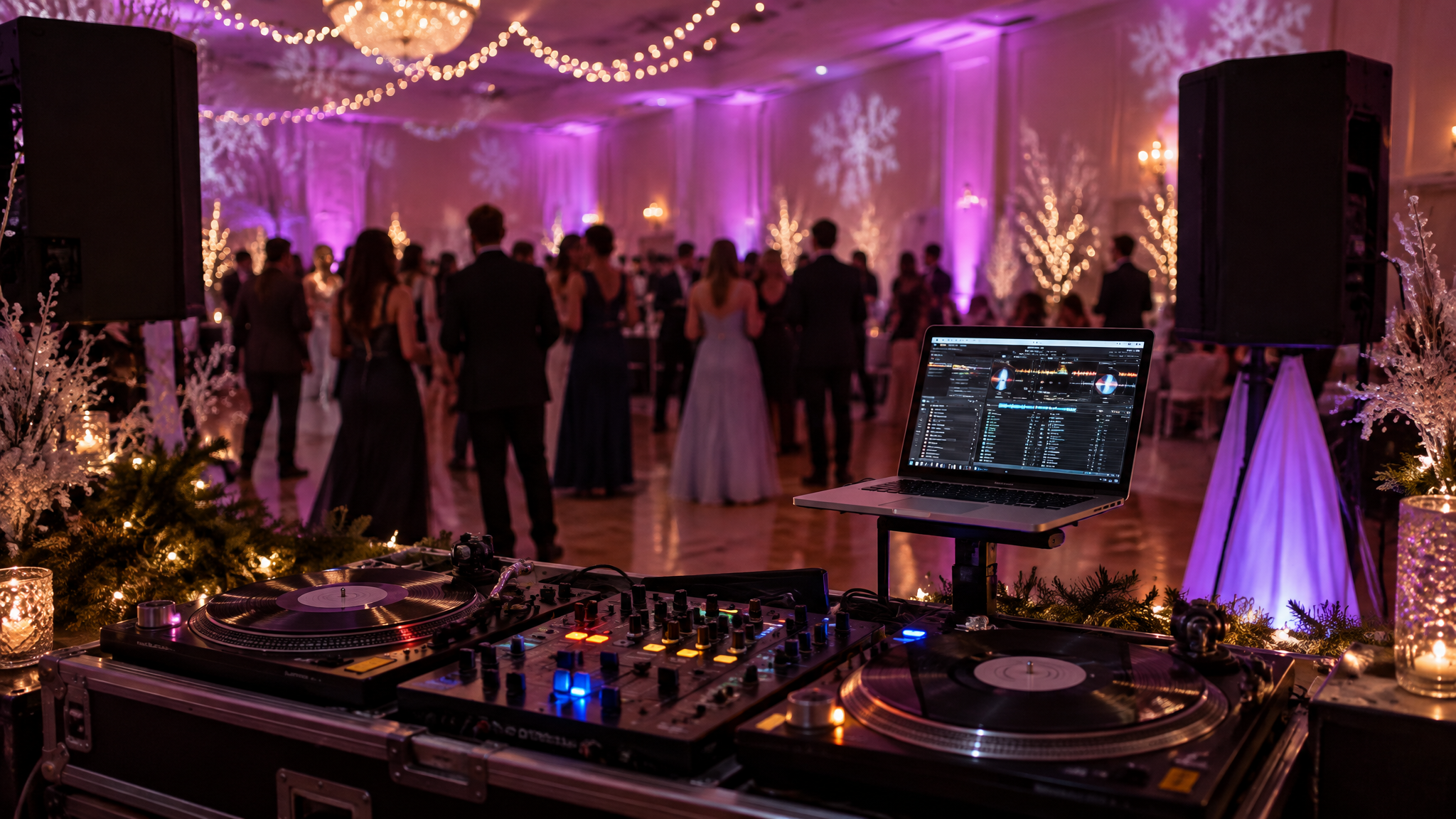
Most winter formals rely on lighting to turn an everyday room into a formal one. Decide early what the room needs: power access, load-in time, a spot for the DJ table, and any limits on stands or cables. Ask your entertainment vendor for their setup and teardown needs in writing, and share them with the venue or the custodial staff.
Pick a theme students will actually support
Both guides recommend asking students rather than guessing. A short survey or vote gives the committee a mandate and builds attendance. Popular winter themes in the sources include winter wonderland, masquerade, and starry night, but the best choice is the one your students pick and your budget can support.
Keep the theme simple enough that decor can be built in one afternoon. A theme that depends on a hard-to-find prop becomes a problem the week before the dance.
Plan the music before the night
TouchWall describes a simple music arc: mid-tempo songs to warm up the room, higher-energy tracks at the peak, and familiar favorites to wind down. It is a useful shape for a formal because students arrive in stages and rarely fill the floor in the first half hour.
Write the music rules down
Tell your entertainer what your school expects, including explicit lyrics, derogatory language, and any request process. Agree on how students can submit requests and who has the final say. A short written policy avoids mid-dance arguments and protects both the advisor and the DJ.
| Question for the entertainer | Why it matters |
|---|---|
| What equipment do you bring and what do you expect the venue to provide? | Prevents power and access surprises on the day |
| How do you handle song requests? | Keeps the request process fair and school appropriate |
| Can you work from a clean-version policy? | Matches your administration's content rules |
| How long do you need to set up and tear down? | Sets the venue access window |
| Who is the on-site contact during the event? | Gives the advisor one person to talk to |
Planning a spring dance as well? The same music and timing choices carry over to prom. Explore prom DJ and MC planning
Safety, supervision, and entry
Administrators will ask for a written safety plan, so it helps to build one early. Both sources describe the same core pieces: enough chaperones, clear positions, a controlled entry, and rules that students see more than once.
Chaperone ratios and positions
TouchWall suggests at least one adult for every twenty to thirty students, with school resource officers or professional security added for larger events, and it names more than 200 students as that point. Chaperones work best when each one has a zone: entrances and exits, restrooms, parking areas, and any dim corner of the room. Your district may set its own ratio, and that rule overrides any general guideline.
Entry and conduct rules
- Check student ID at the door and use wristbands if your school allows them.
- List prohibited items on the ticket and again in school announcements.
- Explain the dress code and guest policy before tickets go on sale.
- Decide ahead of time how warnings, removal, and parent contact will work.
- Share the emergency plan with every chaperone before doors open.
Clear rules published early reduce the number of on-the-spot decisions the night of the event. Students who read the rules on a ticket and in a school announcement rarely say they did not know.
Budget and fundraising for a smaller event
A winter formal is often smaller than prom, but the same cost categories apply: venue, entertainment, decor, food, photography, and security. List every one and collect written quotes. The My School Dance guide notes that ticket sales, fundraising, and local sponsorships can all contribute, and that planning for revenue early gives the committee room to adjust.
Keep one budget record with one owner. Compare actual costs against the plan at each committee meeting, and keep a contingency for the small things that go wrong. If you want a fuller walkthrough of building a budget from total cost, our prom budget guide uses the same worksheet approach.
After the dance: close the loop
Plan the cleanup crew before the event, not after it. Send thank-you notes to chaperones, vendors, and student volunteers, and collect feedback from students while the night is fresh. Write down what worked and what to change so next year's committee starts ahead.
Large or multi-room formals may need a production plan with staging, lighting, and sound together. Learn about school event production
Common winter formal mistakes
- Picking a date that clashes with exams, games, or a school play.
- Waiting to ask administration who signs contracts.
- Choosing a theme that needs props nobody can find.
- Skipping a written music policy and request process.
- Leaving chaperone positions unassigned until the night of the event.
- Forgetting to plan cleanup and a feedback step.
Most of these come down to the same habit: decide early, write it down, and give each task one owner.
Common questions
How far ahead should we plan a winter formal?
Planning guides suggest about twelve weeks. Shorten it only if your date and venue are already settled, and remember the holiday break reduces working time.
How many chaperones do we need?
A common guideline is one adult for every twenty to thirty students, with extra security for larger events. Check your district's own ratio, because it takes priority.
Who should sign contracts with the venue and DJ?
In many schools only a designated administrator can sign. Ask early who that is and how much review time they need.
How much space do we need per guest?
Sources suggest about two to three square feet per person for the dance floor and ten to twelve for seating. Confirm against your venue's posted capacity and fire code limits.
What should we tell the DJ about music?
Share your school's content rules, how requests will be handled, and who has the final say. A short written policy prevents arguments during the dance.